
 6 PROF. ASSEN ZLATAROV STR., OFFICE 3, VARNA 6 PROF. ASSEN ZLATAROV STR., OFFICE 3, VARNA  +359 52 802 163 +359 52 802 163  OFFICE@RAPIV.ORG OFFICE@RAPIV.ORG   |
  |
 |
|

|
STREAM IT Mentoring Program in Bulgaria How can a young researcher present a complex research project in a clear, memorable, and accessible way to people outside their field of expertise? .jpg)
This key challenge was at the heart of the Bulgarian STREAM IT mentoring programme on science communication, implemented by RAPIV from February to April 2026. The programme supported Bachelor’s, Master’s, and PhD students with research interests in computer science, engineering, technology, mathematics, and the arts. Its aim was not simply to help participants prepare better presentations. The programme encouraged them to identify the value of their research, understand the needs of different audiences, and communicate complex ideas more clearly and confidently. The Bulgarian programme was structured as a progressive learning process, with each stage building on the previous one. It combined online group training, practical assignments, small-group work, and individual mentoring. Participants worked across several interconnected areas:
• understanding the essence of science communication and how it differs from a traditional academic presentation; • identifying personal strengths, development needs, and communication goals; • building confidence and a professional scientific profile; • exploring different channels and formats for communicating research; • improving verbal, non-verbal, and visual presentation skills; • adapting specialised content for academic and non-academic audiences; • preparing and refining an individual presentation for the national competition. The programme also addressed the practical aspects of public speaking, including articulation, pace, pauses, intonation, eye contact, body language, and the visual design of presentation materials. Participants delivered practice presentations, experimented with different approaches to explaining their research, and received detailed feedback on both the scientific content and the way it was communicated. The training began with an introductory Bootcamp on 18 February 2026 and continued with modules focusing on confidence and personal scientific branding, effective science communication, communication and presentation skills, and preparation for the national competition. The mentoring process concluded with an assessment of the participants’ progress and their future development needs. Throughout the programme, participants received support from three mentors with complementary academic and professional backgrounds. Dr Antonina Ivanova contributed her extensive experience in higher education, software engineering, digital transformation, educational technologies, and mentoring Bachelor’s, Master’s, and PhD students. The mentors’ diverse professional backgrounds enabled participants to receive feedback from different perspectives, including scientific accuracy, pedagogical approaches, audience awareness, practical applicability, and effective presentation. The mentors worked with participants both during the thematic training sessions and through individual consultations. Together, they identified the most relevant information, defined the core message of each project, simplified specialised terminology, and developed presentations tailored to different audiences. During the final stage, participants worked in small groups and took part in individual mentoring sessions. Their presentations were delivered, discussed, and refined several times. The mentoring process encouraged them to consider several key questions:
Through this process, participants moved beyond the traditional presentation of methods and results typical of scientific conferences. They learned to communicate their research as a coherent narrative, with a clearly defined problem, a proposed solution, supporting evidence, and potential benefits. The Programme concluded with the National Science Communication competition, which was held on 29th April 2026.
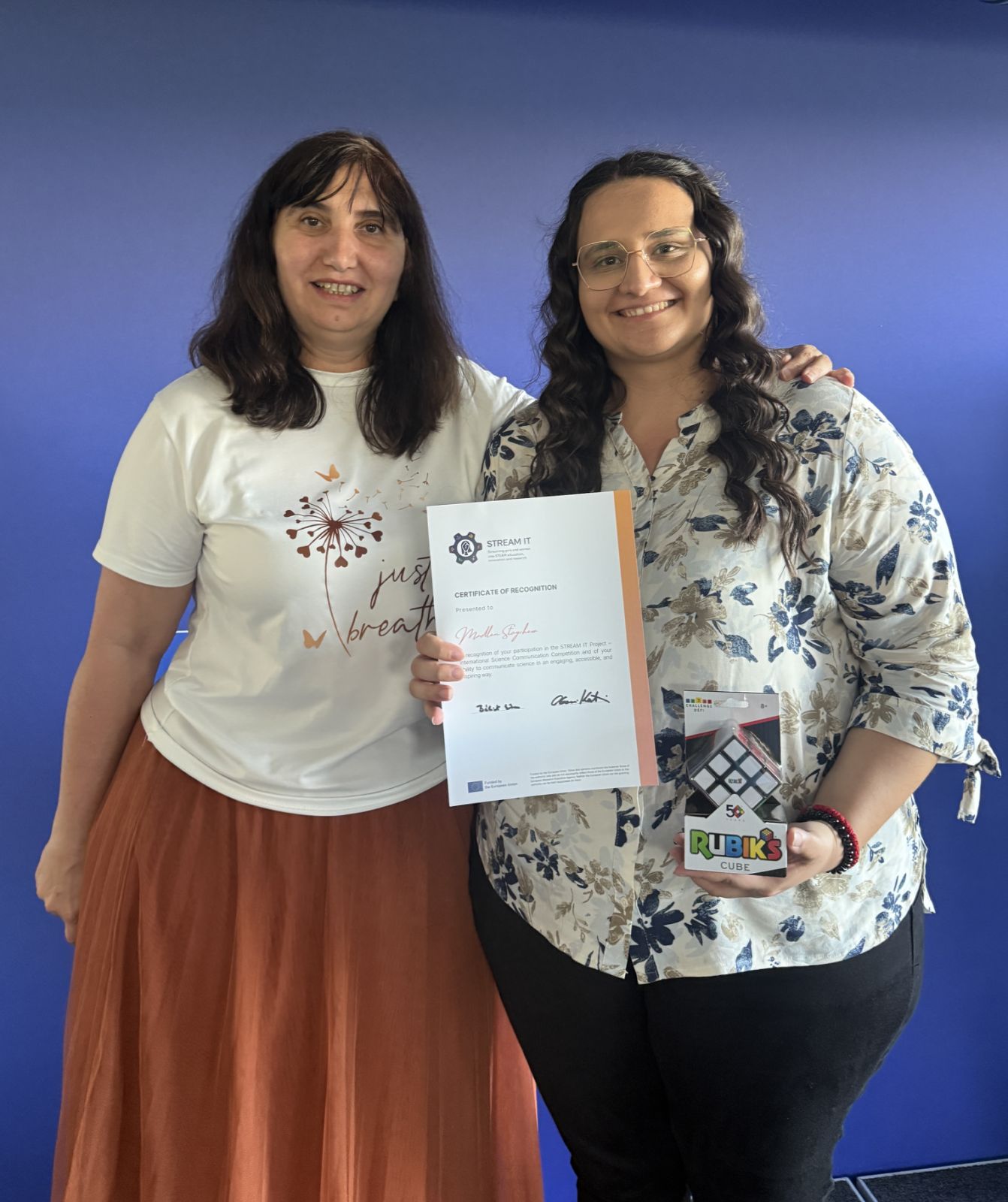
Participants presented their research projects to a jury, demonstrating not only in-depth knowledge of their topics but also the ability to communicate complex ideas in a clear, compelling, and accessible way. Although the presentations covered different areas of computer science and digital technologies, they all followed a common approach. Each participant began with a real and relatable problem, presented a scientific or technological solution, and explained why their research matters beyond academia. First Place: Making Complex Computer Technologies Easy to UnderstandFirst place went to Madlen Stoycheva for her presentation, “Design, Containerization and Performance of Distributed Evolutionary Computation.” She presented a challenge that is easy to understand even for people without a background in computer science: some optimisation problems are so complex that a single computer cannot process them efficiently enough. To explain evolutionary algorithms, she used an analogy with selective breeding. She then demonstrated how the system automates the process using Docker containers and visualises its execution through an interactive dashboard. The presentation also included specific results: up to 10 times faster data transfer, Docker overhead of less than 7%, and the highest performance achieved using a server with 128 CPU cores. Through analogies, visual explanations, and concrete examples, Madlen demonstrated how a highly technical topic can be made accessible and engaging for researchers, developers, and industry representatives alike. Second Place: Why Cybersecurity Needs to Be Adaptive Second place was awarded to Vladimir Handzhiev for his presentation, “When Fixed Methods Fail in Dynamic Environments: Adaptive Network Intrusion Detection.” He explained the problem through an easy-to-understand comparison: the same diagnosis is not appropriate for every case. He then applied this idea to cybersecurity, where the behaviour of both legitimate and malicious network traffic is constantly changing. Vladimir presented an adaptive model that combines different mechanisms and adjusts its decisions according to the specific situation. The key message of his presentation was clear: when the same method is applied regardless of changing conditions, the method itself becomes a limitation. Dynamic environments require solutions that are capable of adapting. Third Place: Protecting Digital Healthcare Third place was awarded to Yana Yordanova for her presentation, “AI-Driven Zero-Trust Models for Blockchain-Supported Healthcare Ecosystems.” She presented a security architecture that combines artificial intelligence, Zero Trust principles, and blockchain technologies to protect sensitive health data. The solution was presented as a three-step process: 1. Artificial intelligence analyses risk and detects unusual behaviour.. 2. The Zero Trust model determines whether access should be granted. 3. Every action is recorded on the blockchain. The model achieves 95.2% accuracy in threat detection, with a 2.4% false-positive rate, demonstrating a good balance between security and performance. The presentations demonstrated that effective science communication does not require every researcher to use the same style.
What the three presentations had in common was that they went beyond simply presenting technical results. They explained why the problem matters, who could benefit from the solution, and what the audience should take away from the presentation. From Bulgaria to the International Stage The two highest-scoring participants qualified for the STREAM IT International Science Communication Competition, held in Budapest on 16 June 2026. Following her victory, Madlen Stoycheva continued working with her mentor, Dr Antonina Ivanova, to adapt her presentation for an international audience. Together, they represented Bulgaria at the international competition. Her participation demonstrated that a strong presentation is the result of months of training, repeated practice, feedback, and individual mentoring. Impact Beyond the Competition Although the national and international competitions were important milestones, the programme was designed with a longer-term objective in mind. Participants developed skills that they can apply when presenting at scientific conferences, applying for project funding, pitching their work to companies and investors, taking part in public events and interviews, and communicating with representatives from different scientific fields. They also became part of a community of motivated young researchers who exchange experiences and learn from one another. For RAPIV, this is one of the programme’s most valuable outcomes. Effective science communication goes beyond delivering a good presentation. It builds connections between science and society, demonstrates the practical value of research, and encourages public interest in science and innovation.
This individual approach was particularly important given the significant differences between the participants’ research topics. There was no one-size-fits-all model for an effective presentation. Each researcher had to find their own balance between scientific accuracy, accessibility, and an authentic personal style.
|

|
 |
 |
 |
 |
REGIONAL AGENCY FOR ENTREPRENEURSHIP AND INNOVATIONS – VARNA (RAPIV) |
Varna, Bulgaria tel.: +359 882 809 178 +359 52 802 163 office@rapiv.org |


